Direct Mail ROI: How to Measure It Without Fooling Yourself
Direct mail ROI is the most argued-about number in marketing, and for a strange reason: the channel with the best benchmark return in the industry is also the one most lenders can't measure internally. Industry studies peg direct mail at roughly $58 returned per dollar spent — against about $19 for paid search and $7 for email — yet ask three executives at the same lender what their mail program returns and you'll get three numbers and an argument.
The problem isn't the channel. It's that most ROI math stops at the wrong line, on the wrong clock. Here's how to measure it honestly.
How to measure ROI of a direct mail campaign: start with the right window
In our last deep dive (https://loansure.ai/news/the-response-curve-direct-mail-marketing-decays), we looked at the response curve — how mail builds to a peak around days three to seven and keeps pulling responses past week six, while digital blasts spike and vanish within days. That curve is the first measurement trap.
If a channel pays out over six weeks, day-five math is fiction. Judge a mail drop in its first week and you'll cancel campaigns that were about to pay for themselves; worse, you'll reallocate the budget to a spike channel whose entire return showed up early and flattered the comparison. Long-tail channels demand long windows: rolling multi-week averages, not campaign-week snapshots. Anyone quoting you roi for direct mail on a seven-day window is measuring the ramp, not the return.
Measure to the right line: cost per lead is not ROI.
The second trap is where you draw the finish line. Most direct mail ROI math stops at one of three false bottoms:
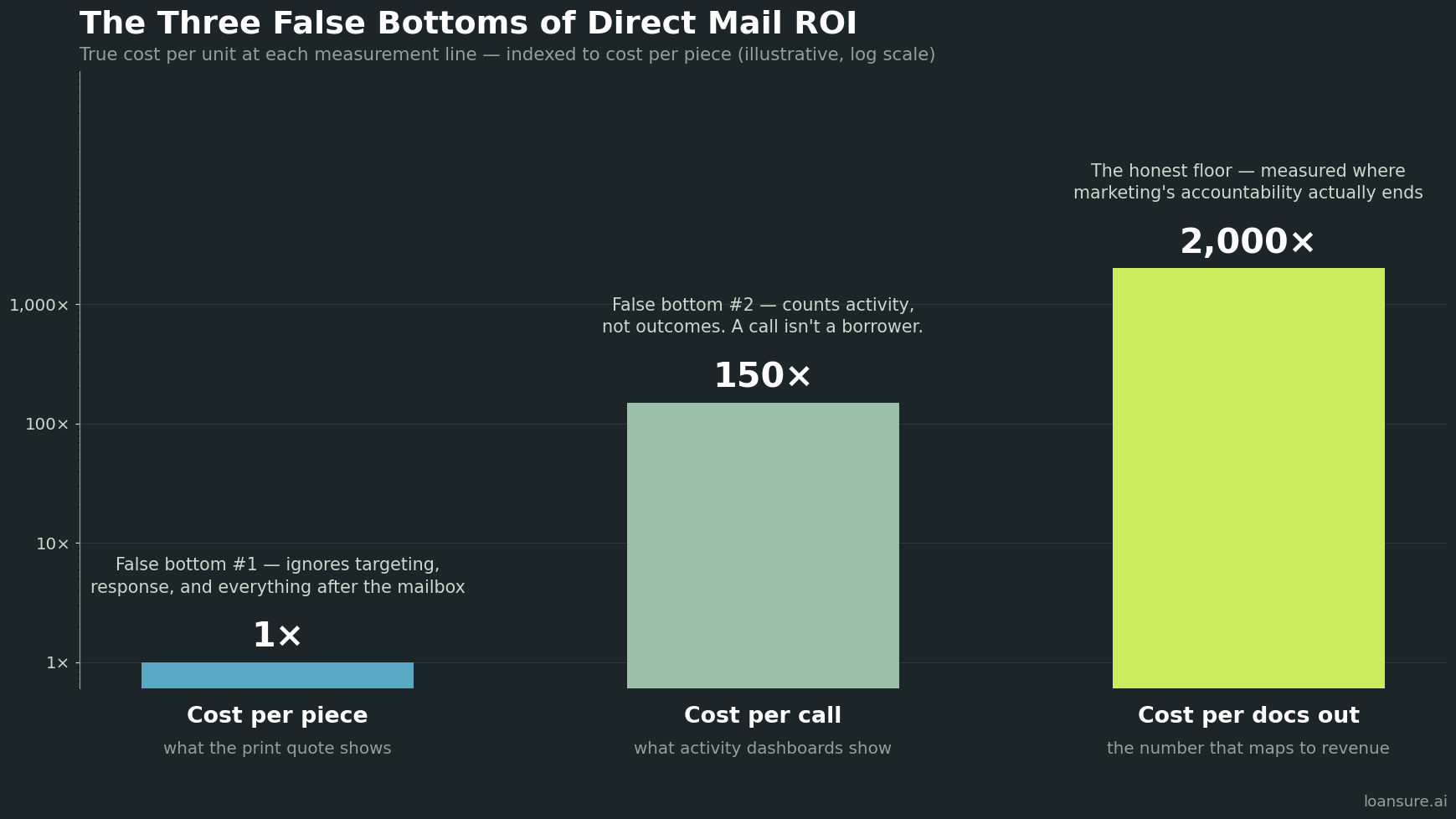
*Cost per piece* is printing math. It's the number vendors love to quote because it's tiny, and it tells you nothing — it ignores targeting quality, response, and everything that happens after the mailbox. A cheap piece mailed to the wrong homeowner is the most expensive thing in marketing.
*Cost per call* is activity math. Better — at least a response happened — but a call isn't a borrower, and dashboards full of call counts have hidden many programs that never produced a loan.
*Cost per docs out* — a submitted application with disclosures sent — is the honest floor. It's the last point in the funnel that marketing can fairly own, and the first number that actually maps to revenue. This is where direct mail ROI in mortgage should be measured, because everything past it (pull-through to funding) belongs to the lender's ops, pricing, and process, not to the marketing.
That last distinction matters more than it looks. A vendor who promises you cost per funded loan is promising to control your pull-through — which they can't. A vendor who won't show you anything past cost per call is hiding. The honest attribution line sits at docs out: fully accountable to outcomes, fully honest about whose funnel is whose.
Direct mail ROI measurement tools: what closed-loop actually requires
"Trust us, it's working" is not a measurement system. Closed-loop direct mail ROI takes real infrastructure, and it's a fair checklist to hold any partner to:
- Call attribution at the source — unique reference IDs tied to every campaign, so each inbound call is matched to the piece, the audience, and the spend that produced it.
- Funnel reporting past the call — calls to conversations to docs out, visible by campaign and by week, not summarized in a quarterly PDF.
- A planning layer — a CPA simulator that models what a change in volume, audience, or mix does to acquisition cost *before* you spend, not after.
- Data that flows back — outcomes returned to your CRM or via SFTP feed, so your system of record and your marketing math agree.
- Rolling-window views — performance rendered on the multi-week timescale the response curve actually plays out on.
If a vendor can't show you these, they're not measuring ROI — they're estimating it, usually generously.
The four ways lenders fool themselves
Even with good tools, the same mistakes keep showing up:
1. Judging the curve on the spike's clock. Mail evaluated at day five against digital evaluated at day five isn't a comparison; it's a rigged race.
2. Crediting the last click. A homeowner gets a letter, searches your name, clicks a paid ad, and calls — and the ad takes the credit. Branded-search lift during mail windows is mail ROI wearing a disguise.
3. Ignoring multi-touch lift. Mail synchronized with digital retargeting outperforms either alone over multiple weeks; measuring each channel in isolation undercounts both.
4. Comparing channels on response rate. A 4% response channel and a 0.5% response channel tell you nothing until you know the cost per outcome behind each. Response rate is a diagnostic, not a scoreboard.
The takeaway
Direct mail ROI isn't a number a vendor hands you at the end of the quarter. It's a measurement system — the right window, the right line, and the infrastructure to close the loop — that you should demand before the first piece mails.
We built our system around that standard: every campaign attributed at the call, reported through the funnel, and measured where it counts — at docs out, on rolling averages, in the open. Not because the numbers are always comfortable, but because a program you can't measure honestly is a program you can't improve.
Want to see what closed-loop measurement looks like on a live portfolio — funnel, simulator, and all? Let's talk strategy.